Dream of Moon
By DreamBunny Editorial Team · Last updated November 13, 2026
Dreaming of the moon often reflects emotional rhythms, intuition, and what is becoming visible in a changing phase of life.
Introduction
The moon can make a dream feel unusually intimate. It may hang above a familiar street, slip behind a cloud, or lay a silver path across water. The light feels personal, as if it has been waiting for you to look up.
It is tempting to treat the image as a prediction: a full moon means completion, an eclipse means bad news. Dream research does not support a fixed dictionary of symbols. The moon is more useful as a mirror for rhythm—what is changing, what is still hidden, and what you can finally see.
The phase, the quality of light, and your emotion matter more than any single meaning. This article offers reflection prompts, evidence boundaries, and small waking actions. Take what fits and leave the rest.
Core Symbolism
Across traditions, the moon marks time: it waxes, wanes, disappears, and returns. That cycle makes it a natural image for change, reflection, intuition, and emotional life. Unlike the sun, which suggests clear visibility and conscious direction, the moon is associated with softer attention—what you sense before you can explain it.
Its most useful psychological quality is that it changes shape without disappearing. That makes it a container for experiences that are temporary but recurring: grief that returns in waves, creativity that needs fallow periods, attachment that alternates between closeness and distance, or rest that is not failure. A bright moon may mean something is becoming visible enough to name; a dark moon may mean the naming is not ready.
The shadow side is passivity ("I will wait until I feel ready"), romantic idealization, or the belief that feelings are fate. The better question is not "What does the moon promise?" but "What am I being asked to notice, and what is one proportionate response?" Personal associations often outrank general symbolism.
Common Dream Scenarios
A full, bright moon
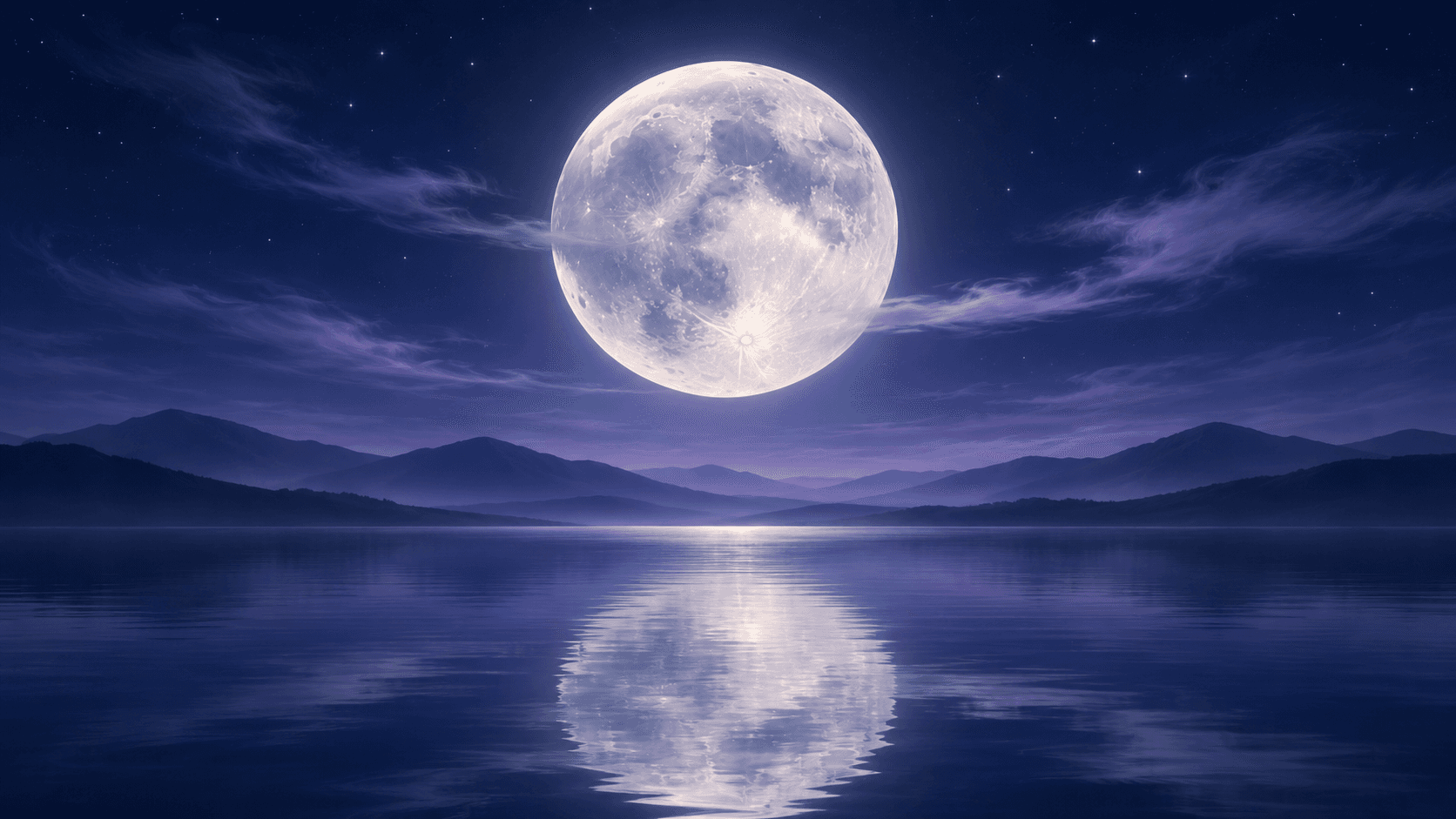
A full moon arrives with a sense of exposure. The landscape is suddenly visible; there is nowhere for a feeling to hide. In a dream, this can accompany a situation at its natural peak—a decision you cannot postpone, a truth you have half-admitted, or an emotion too large to keep in the background. It does not mean the situation is resolved, only that you have enough light to respond honestly.
If the brightness felt comforting, it may reflect confidence; if it felt accusing, shame or fear of being seen. Try this: name one thing that became clearer this week and choose a step you can take within 24 hours.
A thin crescent or a new moon
A crescent is mostly darkness with a little light. That ratio can mirror a beginning: a project, a relationship, or a way of living not yet formed. The dream may feel tender, uncertain, or quietly hopeful. You may be asked to trust a process before you have evidence.
A new moon can also reflect a fallow period; not every darkness is a crisis, and some of it is incubation. The risk is demanding certainty too early or abandoning a good beginning because it does not look impressive yet. Try this: protect the beginning with one repeatable commitment rather than a dramatic resolution.
A moon hidden by clouds or an eclipse
Clouds and eclipses often accompany blocked perspective: fatigue, competing demands, grief, or a conversation that has not happened. The dream may carry frustration or an eerie calm. An eclipse feels cosmic, which makes it easy to read as an omen, but the grounded reading is simpler: something important is temporarily obscured.
Obscurity is not loss; the moon has not gone anywhere, only your access to it has changed. Try this: postpone all-or-nothing conclusions for a day and arrange one thing—rest, information, or support—that would improve your view.
Walking or flying toward the moon
Moving toward the moon can signal longing, curiosity, or a pull toward an ideal. You may walk an empty road, fly above a landscape, or reach for something that stays the same distance away. Excitement supports exploration; fear or exhaustion may reveal pressure to meet an impossible standard.
Direction matters: approaching can reflect healthy aspiration, never arriving can reflect perfectionism, and turning back can reflect self-protection. Try this: separate the goal you want from the standard you think you must meet, then name one version allowed to be imperfect.
Several moons or a moon that changes shape
More than one moon is disorienting. The sky no longer behaves as it should, and you may feel awe, anxiety, or strange possibility. This can accompany competing priorities, a shifting identity, or a period when several versions of your life feel plausible.
A moon that changes shape while you watch says the same thing: change is not hypothetical; it is happening in front of you. Try this: list the options pulling at you and mark the one you would choose if you did not need to justify it to anyone.
When the Image Reverses
Opposite details are often the most useful part of a dream. A moon reflected in still water may suggest contemplation; a moon that falls or cracks may suggest fear that your feelings are unreliable. Looking at the moon can feel like being watched; turning your back can feel like avoidance or self-protection. A moonless night is not simply a bad omen—it may show that you are not ready to see something yet.
These reversals are different intensities of the same theme: visibility, rhythm, and the line between what you show and what you hide. Ask what changed between the images, and what that change matches in waking life.
Multiple Perspectives and Evidence Boundaries
Jungian perspective
In Jungian psychology, the moon is linked with the anima, the unconscious, and the receptive side of the psyche. A lunar figure may appear as guide, witness, or distant presence. Do not decode a fixed archetype; notice which part of your inner life the image personifies. If the moon feels maternal, ask what needs care; if judging, ask what standard you have internalized.
Freudian perspective
Freudian readings treat dream imagery as disguised wish, anxiety, or memory. A moon could represent longing, a return to an earlier stage, or something concealed by darkness. This can help you notice avoidance, but a single image is not proof of a hidden conflict.
Cognitive and sleep-science perspective
Contemporary research treats dreams as products of sleeping brain activity, memory, and emotion. Most dreaming occurs during REM sleep, though dreams are also reported from non-REM sleep. The continuity hypothesis suggests dreams often reflect waking concerns, and emotionally salient material is more likely to appear. None of this gives the moon a universal meaning, but it makes a moon dream more likely when change or uncertainty is already active.
Cultural perspective
Lunar calendars, harvest festivals, and folklore give the moon rich language: reunion, longing, renewal, impermanence. These traditions can enrich a journal but are not evidence about your future or health. Use them as vocabulary, not instructions.
Evidence boundaries
Research supports links between sleep, memory, and emotion; it does not support using a moon image to predict events, diagnose a condition, or make a major decision. Dream emotion and next-day mood interact in complex, individual ways. If a dream leaves you distressed, examine sleep, stress, and support rather than searching for the correct symbol.
Reflection and Action
Questions to ask yourself
- What phase was the moon in, and how does that match my current energy?
- Was the light comforting, exposing, distant, or frightening?
- Was I moving toward the moon, away from it, or watching it?
Small waking exercises
- Write before you interpret. Within 24 hours, record the clearest visual detail, the strongest emotion, and one line about yesterday.
- Rate the basics. Score sleep quality and stress from 1 to 10. If either is extreme, address that before assigning meaning.
- Choose one proportionate action. Send the message, ask for the information, take the rest, or make the small decision the dream keeps circling.
- Test the interpretation. Write your hypothesis as a question ("I may be avoiding a conversation about ___") and look for one piece of waking evidence for or against it.
Frequently Asked Questions
Does a full-moon dream predict a major event?
Usually no. A full moon may symbolize visibility or emotional intensity, but it is not reliable evidence of a future event. Ask instead what already feels complete or exposed in your life.
Is an eclipse dream a bad sign?
Not necessarily. It can reflect uncertainty, a temporary lack of clarity, or recent exposure to eclipse imagery. Look at the emotion and context before deciding what it means for you.
Why do I keep dreaming of the moon?
Repetition can mean a theme is emotionally salient, but it is not a diagnosis. If the dreams are merely puzzling, a journal may be enough. If nightmares disrupt sleep or daytime life, consider speaking with a qualified professional.
Does dreaming of the moon mean I have a mental-health problem?
No. Dream content alone cannot diagnose a condition. Unusual imagery is common during stress, grief, illness, or sleep changes. Seek support when distress persists or daily functioning is impaired—not because of one symbol.
Can I change what I dream about?
Not fully. You can influence sleep and emotional context with a consistent schedule, less late-night stimulation, and a wind-down routine. For recurrent nightmares, ask a clinician about imagery rehearsal therapy.
Conclusion
The moon in a dream is less a message than a rhythm made visible. Its phase, its light, and your position in the scene can show where you are in a change: beginning, waiting, seeing, or integrating. The most useful interpretation is the one that helps you respond more honestly to waking life.
Tonight, you do not need to solve the dream. Record one detail, rate your sleep and stress, and choose one small action that makes the next day more livable. If the image returns, compare the versions rather than forcing a single meaning.
References
- American Psychological Association: Why do we dream?
- National Institute of Neurological Disorders and Stroke: Brain Basics—Understanding Sleep
- National Library of Medicine: Sleep and Dreaming
- Jung, C. G. (1968). The Archetypes and the Collective Unconscious. Princeton University Press.
Disclaimer
This article is for education and self-reflection. It is not a medical or mental-health diagnosis. Seek professional support if distressing dreams are persistent or affect your safety or daily functioning.
Editorial Method and Evidence Boundaries
How this page is written. Dream symbols do not have a validated one-to-one meaning. This article separates the remembered scene, a possible reflection question, and a low-risk waking action. Interpretations are hypotheses for self-reflection, never facts about personality, health, relationships, or the future.
What evidence supports. Most dreaming occurs during REM sleep, although dreams can also be reported from non-REM sleep; sleep, memory, and emotional experience are related, but a particular image does not predict an outcome. The relationship between dream emotion and next-day mood is complex and individual.
When to seek support. If nightmares, trauma-related sleep disturbance, anxiety, or low mood persist or impair daily functioning, contact a qualified health or mental-health professional rather than relying on symbolic interpretation.
Additional Sources
Had a dream about Moon?
Get a personalized, in-depth analysis of your specific dream context with our AI therapist.
Related Dreams
Forest Dream Meaning
Explore the deep symbolism of forests in dreams. From the mysterious unconscious to personal growth, discover what getting lost or finding peace in the woods reveals about your inner journey.
Flood
Dreaming of a flood often reflects emotional overflow, boundary collapse, or rapid life transitions. This guide explains flood dream meaning through Jungian, Freudian, cognitive, and cultural lenses.

Water
Dreaming of water usually reflects emotional state, unconscious processing, and life transitions. The water’s clarity, force, and your reaction reveal whether the dream points to regulation, overwhelm, healing, or unresolved stress.
Thunder
Dreaming of thunder often reflects emotional shock, suppressed conflict, or a wake-up signal from the psyche. This guide explains thunder dream meaning through Jungian, Freudian, cognitive, and cultural lenses.
Fire
Dreaming of fire often reflects intense emotional energy, transformation, and control anxiety. The fire’s size, location, and your reaction reveal whether you are processing renewal, anger, fear, or unresolved pressure.
Rain
Dreaming of rain often reflects emotional release, grief processing, or psychological renewal. This expert guide explains rain dream meaning through Jungian, Freudian, cognitive neuroscience, and cultural perspectives.