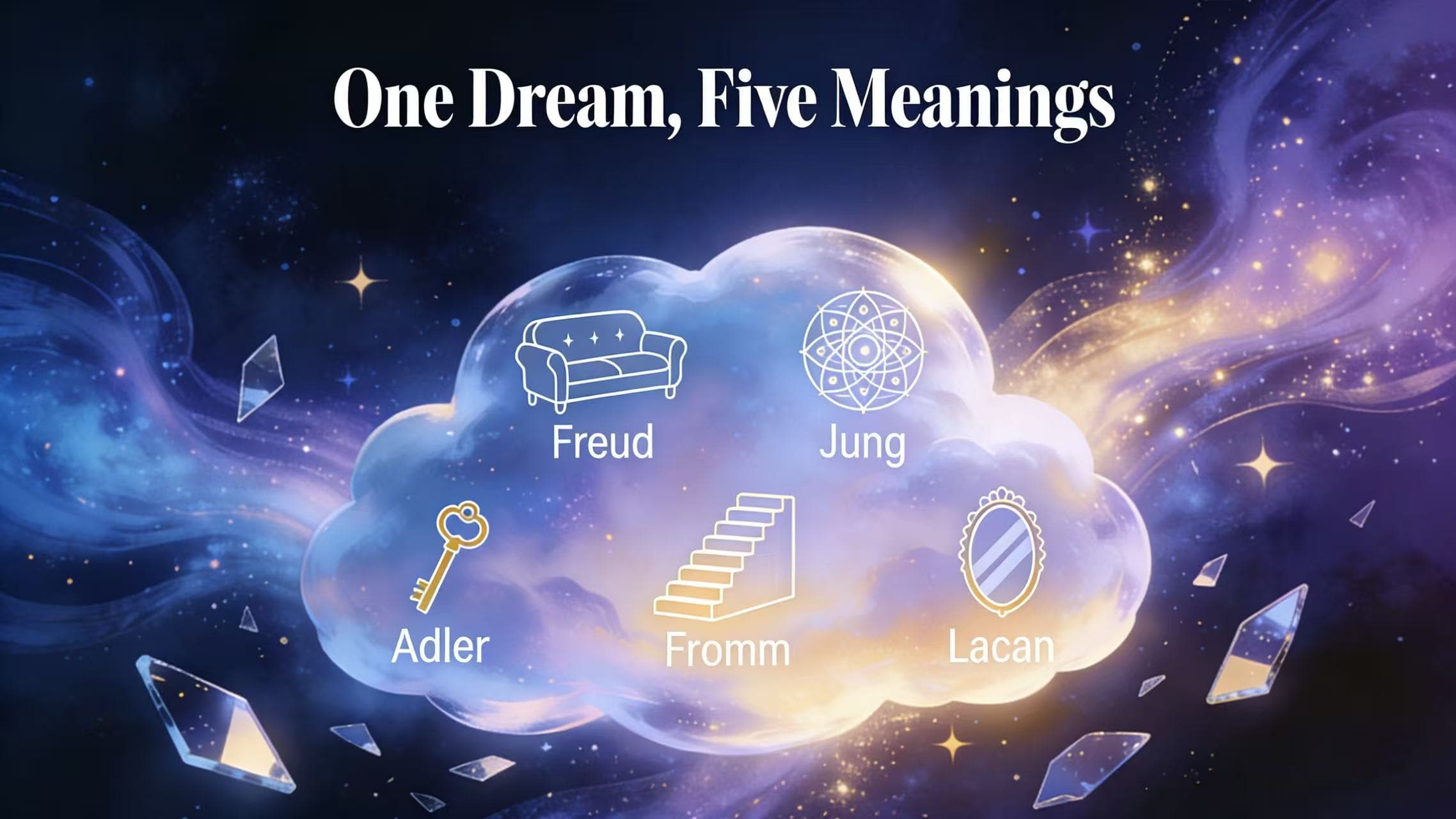
One Dream, Five Meanings: A Guide to the Different Schools of Dream Interpretation
Introduction
"Dreams are the royal road to the unconscious." — Sigmund Freud
Imagine you dream of a house burning down. It’s vivid, terrifying, and you wake up with your heart pounding. What does it mean?
If you bring this dream to a Freudian analyst, they might gently probe into your childhood, asking about your relationship with your father and suppressing anger. If you ask a Jungian analyst, they might see the fire as a symbol of transformation—the destruction of the old self to make way for the new. If you visit a Gestalt therapist, they won't analyze you at all; they will ask you to become the fire and speak from its perspective. And if you consult a Neuroscientist, they might tell you your brain is simply "taking out the trash," processing the stress of a looming deadline with no hidden message attached.
I have spent the last decade exploring these different terrains—from sitting on the leather couch of psychoanalysis to keeping a rigorous dream journal for neurobiological tracking. What I’ve learned is that "Dream Interpretation" isn't a single, monolithic practice. It is a vast spectrum of theories ranging from the strictly clinical to the deeply mystical.
Understanding these different "schools" is crucial because the lens you use determines the message you receive. A dream is a multi-faceted gem; turn it one way, and it reflects your past; turn it another, and it illuminates your potential future.
In this comprehensive guide, we will break down the major schools of dream analysis. For each school, we will explore its core philosophy, how it analyzes a specific dream scenario, and—crucially—how it feels to experience this method first-hand.
1. The Psychoanalytic School (The Freudian Approach)
The Vibe: Detective work, excavation, uncovering taboos, looking backward.
Sigmund Freud, the founder of psychoanalysis, revolutionized the way we think about the mind with his seminal 1899 work, The Interpretation of Dreams. Before Freud, dreams were largely dismissed as nonsense or elevated as divine prophecy. Freud grounded them in the human psyche.
Core Philosophy: The Disguised Wish
Freud believed that dreams are essentially wish fulfillment. However, these wishes are often primitive, sexual, or aggressive—desires that our civilized, waking "Ego" finds unacceptable. To protect our sleep and our self-image, the "Dream Censor" disguises these wishes using symbols.
- Manifest Content: The dream as you remember it (e.g., a King and Queen sitting on a throne).
- Latent Content: The hidden, true meaning (e.g., your parents and your feelings about them).
- Dream Work: The process of distortion, primarily through displacement (shifting emotion from an important object to an insignificant one) and condensation (merging multiple ideas into one image).
In Practice: The Case of the "Missed Train"
The Dream: You are running desperately to catch a train, but the doors close just as you arrive. You feel a sense of crushing defeat.
The Freudian Analysis: A Freudian wouldn't just look at the train. They would ask for your free associations. Perhaps the train reminds you of your father leaving for work when you were a child. The "missed train" might not be about being late to a meeting, but a symbol for a missed opportunity for love or a fear of castration (a classic Freudian trope for loss of power). The dream allows you to vent the frustration of the loss without facing the childhood trauma directly.
The Experience: What It Feels Like
Using this method feels like being a mystery writer decoding your own novel. It requires brutal honesty. When I applied Freudian analysis to my own recurring anxiety dreams, I often found they weren't about the "test" I was failing, but about a deeper, older fear of parental disapproval. It is a method that demands you look into the shadows you usually avoid.
Authoritative Resources
- The Freud Museum London - The final home of Sigmund Freud and a hub for psychoanalytic research.
- The American Psychoanalytic Association - Resources on modern psychoanalytic theory.
2. The Analytical Psychology School (The Jungian Approach)
The Vibe: Mystical, mythological, looking forward, seeking balance.
Carl Jung was Freud’s protégé, but they famously parted ways. While Freud saw the unconscious as a basement of repressed junk, Jung saw it as a treasure trove of wisdom. For Jung, dreams weren't concealing anything; they were trying to communicate.
Core Philosophy: Compensation and Wholeness
Jung introduced the concept of the Collective Unconscious—a universal library of human symbols and history we all inherit. He believed dreams serve a compensatory function. If you are too intellectual in waking life, your dreams might be primal and emotional to balance you out.
Key Jungian concepts include:
- Archetypes: Universal characters that appear in dreams, such as The Shadow (rejected parts of self), The Anima/Animus (the soul image), and The Wise Old Man.
- Individuation: The lifelong process of becoming your true self, which dreams guide you toward.
In Practice: The Case of the "Dark Figure"
The Dream: You are being chased through a dark forest by a shadowy, faceless figure. You are terrified.
The Jungian Analysis: Instead of running away, a Jungian would encourage you to turn and face the figure. This is likely your Shadow—the parts of yourself you have rejected (e.g., your aggression, your selfishness, or your creativity). The dream isn't a threat; it's an invitation. The Shadow is chasing you because it wants to be integrated. By accepting this part of yourself, you become more whole.
The Experience: What It Feels Like
Jungian analysis feels like reading a fairy tale where you are the hero. It is less about "fixing" a pathology and more about "discovering" a destiny. I found this method particularly powerful during life transitions. It transforms a nightmare into a call to adventure. Using Active Imagination (a technique where you meditate and converse with dream figures) can be a profound, almost spiritual experience.
Authoritative Resources
- The C.G. Jung Institute of Zürich - The institute founded by Jung himself.
- The Philemon Foundation - Dedicated to preparing for publication the complete works of C.G. Jung.
3. The Gestalt School (The Experiential Approach)
The Vibe: Dramatic, emotional, "Here and Now", visceral.
Fritz Perls, the founder of Gestalt therapy, famously said, "Lose your mind and come to your senses." While Freud and Jung treated dreams as texts to be analyzed, Perls treated them as scripts to be acted out.
Core Philosophy: You Are the Dream
In Gestalt theory, every part of the dream is a projection of yourself. The people, the objects, the weather—they are all fragmented aspects of your own personality that you have disowned or ignored. The goal isn't to understand the dream intellectually; it is to re-own these parts to become a whole person.
In Practice: The Case of the "Broken Car"
The Dream: You are driving your car, but the brakes fail, and it crashes into a wall. You get out, unharmed but frustrated, kicking the tires.
The Gestalt Analysis: A Gestalt therapist won't ask what the car "symbolizes." They will ask you to be the car.
- Therapist: "Speak as the car. What are you feeling?"
- You (as the car): "I am old. I am tired. You never take care of me. You just drive me until I break. I had to crash just to make you stop."
- The Breakthrough: You realize you aren't frustrated about a car; you are expressing your own physical exhaustion that you've been ignoring.
The Experience: What It Feels Like
Gestalt work is intense and often loud. It bypasses your "smart" brain and goes straight to your gut. I remember "becoming" a locked door in one of my dreams and screaming at the dreamer (me) to find the key. It was a release of anger I didn't even know I was holding. It feels like an emotional exorcism.
Authoritative Resources
- The Gestalt Therapy Network - News and resources for the Gestalt community.
- Esalen Institute - The birthplace of much of the human potential movement, including Gestalt practice.
4. The Neurobiological School (The Scientific Approach)
The Vibe: Logical, physiological, skeptical, reassuring.
This is the school of Allan Hobson (Activation-Synthesis Theory) and Matthew Walker (Why We Sleep). It strips away the mysticism and looks at the hardware.
Core Philosophy: Overnight Therapy
Modern neuroscience views dreaming as a biological function, critical for memory consolidation and emotional regulation.
- Threat Simulation Theory: Dreams allow us to practice surviving dangerous situations (being chased, falling) in a safe environment.
- The "Overnight Therapy" Model: During REM sleep, the brain processes painful memories but strips away the stress neurochemistry (noradrenaline). This allows us to wake up remembering the event without reliving the visceral trauma.
In Practice: The Case of the "Final Exam"
The Dream: You show up for a final exam for a class you haven't attended all semester. You are naked.
The Neurobiological Analysis: This isn't a prophecy of failure. It is likely a stress response. You might be anxious about a presentation at work. Your brain is running a "worst-case scenario" simulation. By practicing the feeling of vulnerability and panic in the dream state, your brain is actually preparing you to handle anxiety better in waking life. It’s not a message; it’s a workout.
The Experience: What It Feels Like
Adopting this view can be incredibly grounding. When I have a terrifying nightmare, instead of spiraling into "What does this mean?", I can tell myself, "My amygdala was just hyperactive tonight because I drank coffee too late." It turns a spiritual crisis into a biological hiccup. It is the most practical tool for dream hygiene.
Authoritative Resources
- National Sleep Foundation - Science-based information on sleep health.
- Matthew Walker’s "Why We Sleep" - A comprehensive guide to the science of sleep and dreaming.
5. The Spiritual & Indigenous School
The Vibe: Sacred, external, prophetic, humble.
Before psychology was invented, this was the only school. From the Senoi people of Malaysia to the Tibetan Dream Yoga practitioners, dreaming has long been viewed as a bridge to other realities.
Core Philosophy: The Bridge Between Worlds
In this view, the "self" is not the only author of the dream. Dreams can be:
- Visitations: Actual contact with the spirits of ancestors or the deceased.
- Prophetic: Precognition of future events (déjà rêvé).
- Big Dreams: Dreams that feel so vivid and numinous that they seem to come from a divine source (God, the Universe, the Great Spirit).
In Practice: The Case of the "Gift from the Grandmother"
The Dream: Your deceased grandmother appears. She looks young and healthy. She hands you a golden key and smiles, but says nothing. You wake up crying happy tears.
The Spiritual Analysis: While a Freudian might say this is a wish to see her again, a Spiritual interpreter would validate the reality of the encounter. The key is a literal gift of blessing or permission. The analysis focuses on the feeling of the presence (the "shiver" of truth) rather than the symbolism. The advice would be to honor the visit—perhaps by lighting a candle or visiting her grave.
The Experience: What It Feels Like
These are the dreams that change lives. I once had a dream of a deceased friend that was so hyper-real, the air in the dream felt different than "dream air." Waking up, I didn't feel the need to analyze it. I just felt a profound sense of peace. This school teaches us to shut up and listen to the mystery.
Authoritative Resources
- International Association for the Study of Dreams (IASD) - A multi-disciplinary organization that honors spiritual perspectives alongside scientific ones.
- The Lucidity Institute - Stephen LaBerge’s research on lucid dreaming.
The Expert's Verdict: The Integrative Approach
After years of studying these schools, here is my advice: Don't be a purist. The human mind is too complex for just one map.
Try this 3-Step Process for your next dream:
- The Reality Check (Neuro): First, ask "Did I eat spicy food? Am I stressed?" Rule out the biological noise.
- The Gut Check (Gestalt): If the dream lingers, pick the strongest image and "become" it. What is it shouting at you?
- The Soul Check (Jung/Spiritual): Finally, ask "What is this dream asking me to grow into?"
Your dreams are a nightly letter from your inner self. It doesn't matter which language you use to translate it, as long as you open the envelope.